 Campbell Steven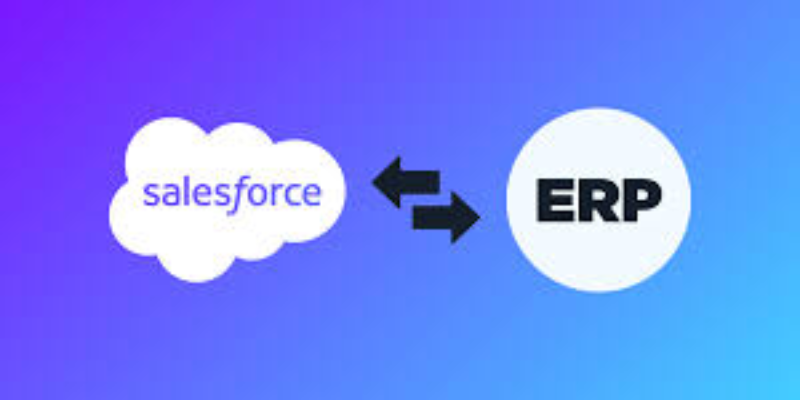
Businesses rely significantly on integrated systems to manage operations effectively in the fast-paced digital economy of today. Managing finance, human resources, inventory, customer data, and operations through disparate technologies gets more complicated as businesses expand. ERP software facilitates data centralization, process automation, and real-time departmental insights for enterprises.
Simultaneously, cloud platforms such as Salesforce have revolutionized the way businesses handle business procedures and customer connections. Salesforce was once recognized as a leader in CRM, but it now offers much more than just sales and marketing. Professionals and business executives frequently wonder if Salesforce can function as an ERP solution in light of this development. We’ll examine what ERP actually entails, how Salesforce fits into the equation, and whether it can actually serve as an ERP solution in this blog.
What Is an ERP System?
A centralized software platform called an enterprise resource planning (ERP) system is used to combine and manage the main business operations of a company. Finance, accounting, procurement, inventories, human resources, manufacturing, and supply chain management are examples of these procedures. ERP’s main objective is to eliminate data silos and enhance decision-making by ensuring that every department uses a single source of truth.
Employees from all departments can now access consistent, up-to-date information thanks to this. For instance, inventory levels, billing, and delivery schedules are instantly updated upon the creation of a sales order. Efficiency, precision, and teamwork are all enhanced by this smooth information flow. SAP, Oracle ERP, Microsoft Dynamics, and NetSuite are well-known classic ERP systems that provide strong modules suited to business requirements.
Core Functions of Traditional ERP Systems
Conventional ERP systems are composed of a number of fundamental modules that facilitate business activities from beginning to end. The general ledger, accounts payable, accounts receivable, budgeting, and financial reporting are all managed by the finance and accounting modules. Payroll, hiring, attendance, and employee performance are all managed via human resource management (HRM) modules. Modules for supply chain and inventory management keep tabs on vendor relationships, logistics, procurement, and stock levels.
Depending on the sector, ERP systems may also have functionality for manufacturing, project management, and compliance. ERP’s tight integration data submitted in one module automatically reflects across others is what gives it its power. This guarantees operational stability, minimizes errors, and cuts down on manual labor. But because traditional ERP systems are frequently complicated, costly to set up, and need a lot of customisation, companies are looking into more adaptable, cloud-based options like Salesforce.
What Is Salesforce and How Has It Evolved?
Salesforce began as a platform for Customer Relationship Management (CRM) with an emphasis on lead, sales pipeline, and customer interaction management. It developed into an all-inclusive cloud ecosystem over time, providing solutions for analytics, application development, marketing, sales, services, and commerce. These days, Salesforce is more than just a CRM; it’s a highly adaptable platform that facilitates a variety of company operations.
Salesforce assists businesses in managing customer journeys from start to finish with solutions like Sales Cloud, Service Cloud, Marketing Cloud, Experience Cloud, and Tableau. With the help of its low-code and no-code tools, such Lightning App Builder and Flow, companies can create unique applications with little to no programming work. Because of its adaptability, Salesforce has established itself as a key business platform, which has led many companies to view it as a possible ERP substitute or supplement. It is great to learn and apply ne concept though Salesforce Training in Chennai and other cities.
Can Salesforce Be Considered an ERP System?
Salesforce is not, strictly speaking, a conventional ERP system. Unlike SAP or Oracle, it does not natively provide complete supply chain, accounting, or finance modules. However, when properly built and linked with other tools, Salesforce can operate as an ERP-like platform. Instead of sophisticated transactional accounting, its strength is in process automation, data visibility, and customisation.
Front-office functions like sales, customer care, partner management, and analytics are all expertly managed by Salesforce. Businesses may expand Salesforce to include order management, inventory tracking, approvals, and even basic financial procedures via custom objects, workflows, and connectors. Salesforce can serve as a consolidated operational hub for small to mid-sized enterprises or service-oriented companies, handling numerous ERP use cases without the complexity of conventional systems.
Comparing Salesforce with Traditional ERP Systems
The distinctions between Salesforce and conventional ERP solutions are evident. ERP systems are made for complex back-office tasks including manufacturing, accounting, and compliance. They are rigid, process-heavy, and frequently less adaptable. In contrast, Salesforce emphasizes flexibility, is cloud-native, and is very user-friendly.
Salesforce is incredibly scalable, particularly for expanding companies that require quick modification. Salesforce may be less expensive at first, but as customisation and third-party integrations grow, it may become more costly. Conventional ERPs come with extensive capabilities right out of the box, but they take longer to setup. In the end, Salesforce is more effective when used in conjunction with other systems or as a lightweight ERP substitute than when used in place of enterprise-grade ERP systems.
Extending Salesforce with ERP Capabilities
Salesforce’s smooth system integration is one of its main advantages. Businesses can integrate Salesforce with supply chain and inventory management systems, as well as accounting programs like NetSuite, Xero, and QuickBooks. The Salesforce AppExchange offers thousands of third-party applications that add ERP-like functionality, such as billing, procurement, and project management.
Businesses can synchronize data between Salesforce and conventional ERP systems by using APIs and middleware products like MuleSoft, which is also owned by Salesforce. This method enables companies to use ERP software for back-end processes while using Salesforce as the front-end interface. The outcome is a cohesive ecosystem that leverages both platforms’ advantages without requiring a total system change.
Real-World Use Cases of Salesforce as an ERP Alternative
Salesforce is a popular ERP solution used by many businesses, particularly in service-oriented sectors. Salesforce is used, for instance, by consulting businesses to handle clients, projects, billing milestones, and resource allocation. Salesforce is used by SaaS organizations for reporting, customer service, renewals, and subscription management.
Salesforce functions as a central data platform that frequently replaces several disparate products in startups and SMBs. Businesses can obtain ERP-like visibility without investing in complicated systems by personalizing objects and automating operations. To manage sophisticated accounting, regulatory, and production requirements, larger manufacturing or finance-focused companies usually combine Salesforce with a conventional ERP.
Best Practices for Using Salesforce in an ERP-Like Role
Businesses should first clearly define their needs in order to adopt Salesforce as an ERP-like solution. Not all ERP features must be duplicated in Salesforce. Pay attention to the procedures that stand to gain the most from automation, visibility, and cooperation. To minimize maintenance complexity, if feasible, use standard Salesforce capabilities before developing custom solutions.
To guarantee data consistency and accuracy, integrations should be carefully planned. Data integrity is preserved with the aid of reporting dashboards, role-based access controls, and routine audits. Lastly, spend money on appropriate training so that users can effectively utilize Salesforce. Salesforce may develop into a strong operational foundation that supports both internal and customer-facing business activities when it is strategically applied.
Conclusion: Is Salesforce the Right ERP Solution for You?
Although Salesforce is not a conventional ERP system, it can supplement or replace ERP based on business requirements. It is perfect for companies looking for scalability and agility because of its flexibility, cloud-native architecture, and robust integration capabilities. Salesforce offers outstanding value for companies that prioritize customer-centric operations.
Nonetheless, businesses with intricate manufacturing, financial, or regulatory needs can still require a specialized ERP system. A hybrid paradigm, in which Salesforce runs front-office operations and a conventional ERP handles back-office operations, is frequently the most successful strategy. You may determine whether Salesforce by itself or in conjunction with an ERP can promote long-term business success by comprehending the objectives and constraints of your company.